
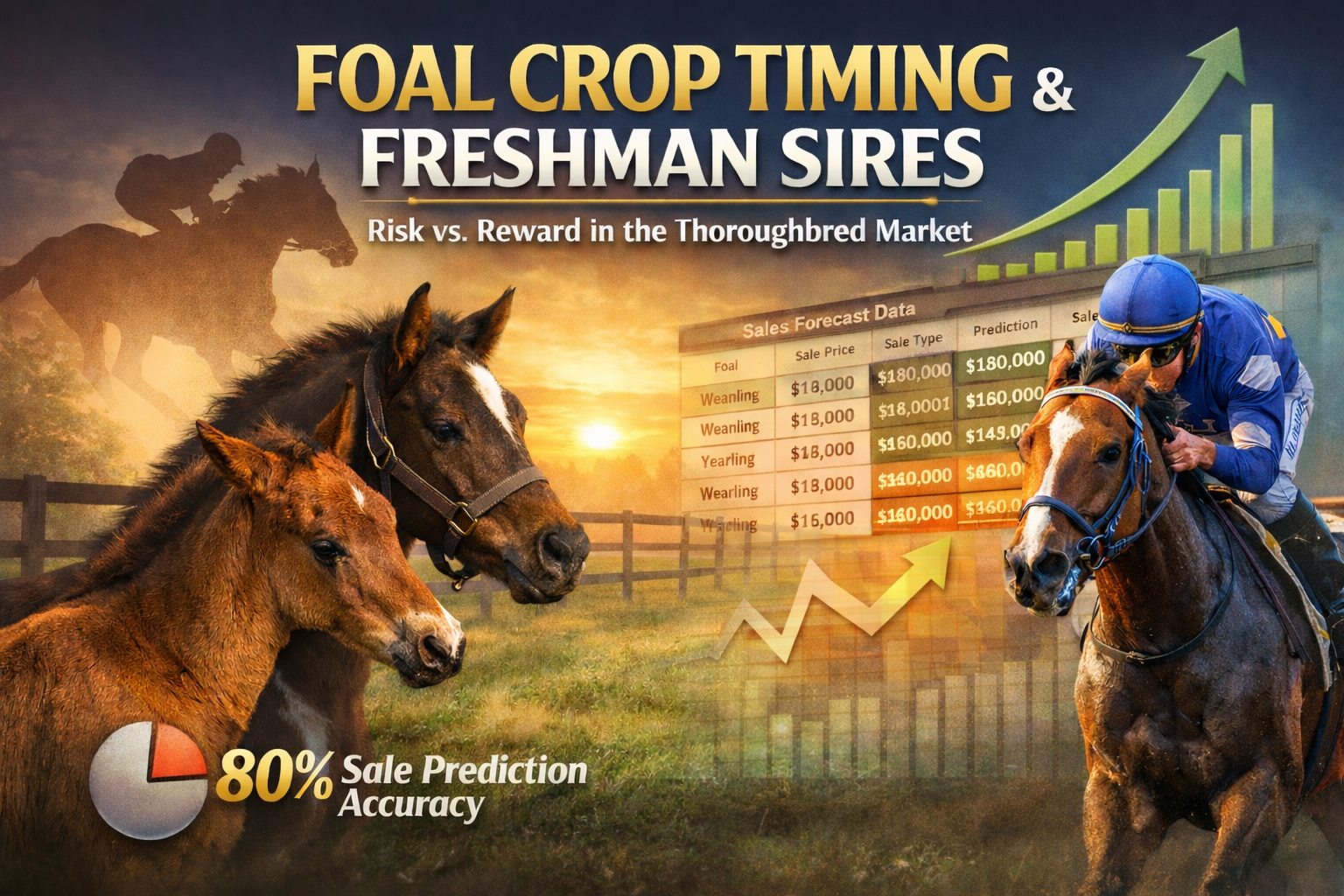
Foal Crop Timing, Freshman Sires, and the Illusion of Certainty
End users are purchasing weanlings earlier to avoid later competition. HorseSense measures how the market prices that decision.
Why End Users Are Buying Weanlings
The Thoroughbred market has shifted. Weanlings now trade at levels once reserved for established yearlings, and buyers are committing capital earlier in the developmental cycle.
This behavior is no longer driven primarily by pinhooker margin. It is increasingly driven by end users, owners buying for their own racing programs, who are accepting earlier stage risk to avoid competing later in deeper, more expensive markets.
What End Users Are Attempting to Achieve
End users purchase weanlings because they believe:
- They can avoid heavier competition in yearling and 2 year old markets.
- They can secure access to individuals that may be unavailable later.
- They accept higher early risk in exchange for perceived pricing advantage.
The logic is straightforward. Paying earlier may feel cheaper than competing at peak demand. The trade off is accepting developmental, structural, and health risk that would otherwise be reduced with age.
Risk Reallocation and Margin Compression
Historically, the structure was clear. Pinhookers absorbed early uncertainty. End users paid more later for reduced risk.
That ladder has shifted.
- End users now carry more early stage developmental risk.
- Pinhookers face tighter margins at higher entry points.
- Risk is retained rather than efficiently transferred.
Risk does not disappear. It moves. When retained by buyers without margin protection, the impact of repeated mispricing becomes more severe.
Freshman Sires and Amplified Volatility
Freshman sires intensify this environment. First crop stallions offer narrative clarity. They have no runners to disappoint and create a sense of scarcity.
When Freshman Sires Succeed
When early crops present consistent physical type and commercial appeal, momentum builds quickly. Buyers reward perceived early signal. Stud fees hold or increase. Market confidence compounds.
When the Market Reprices
Freshman sires fail visibly. If early foals lack consistency or market reception weakens, stud fees are reduced to refill books. These are repricing events, not cosmetic adjustments.
A breeder who entered at forty five thousand dollars may have targeted outcomes three to five times the stud fee. If the fee resets to fifteen thousand, buyer benchmarks adjust immediately. The foal remains the same. The pricing framework changes.
Why Horses Become More Expensive With Age
Horses command higher prices as they age because uncertainty is gradually reduced. As yearlings, buyers evaluate structure. As two year olds, they evaluate movement and athleticism. As runners, projection becomes reality.
Most foals will make at least one race start. A smaller portion will win. A fraction of winners become stakes performers. Paying earlier does not alter those underlying probabilities.
Why Sales Are More Predictable Than Racing
Sale prices respond to observable variables. Physical presentation. Pedigree signal. Sire momentum. Timing and liquidity.
Racing performance depends on additional variables that resist modeling. Soundness over time. Training environment. Mental development. Opportunity. Chance.
What the HorseSense Sales Forecast Measures
The HorseSense Sales Forecast is designed to model market behavior, not to predict racing success.
It evaluates variables buyers consistently price:
- Physical expression at a given age
- Pedigree signal and sire momentum
- Sale timing and demand concentration
- Liquidity differences between present and future markets
Because these drivers move in repeatable patterns, sale outcomes can be forecast with approximately eighty percent directional accuracy. Racing success cannot be projected with similar reliability.
HorseSense does not promise greatness. It clarifies exposure. It measures what the market is likely to pay now, what it may pay later, and how much uncertainty sits between those points.
Horse Sense Sales Analytics