
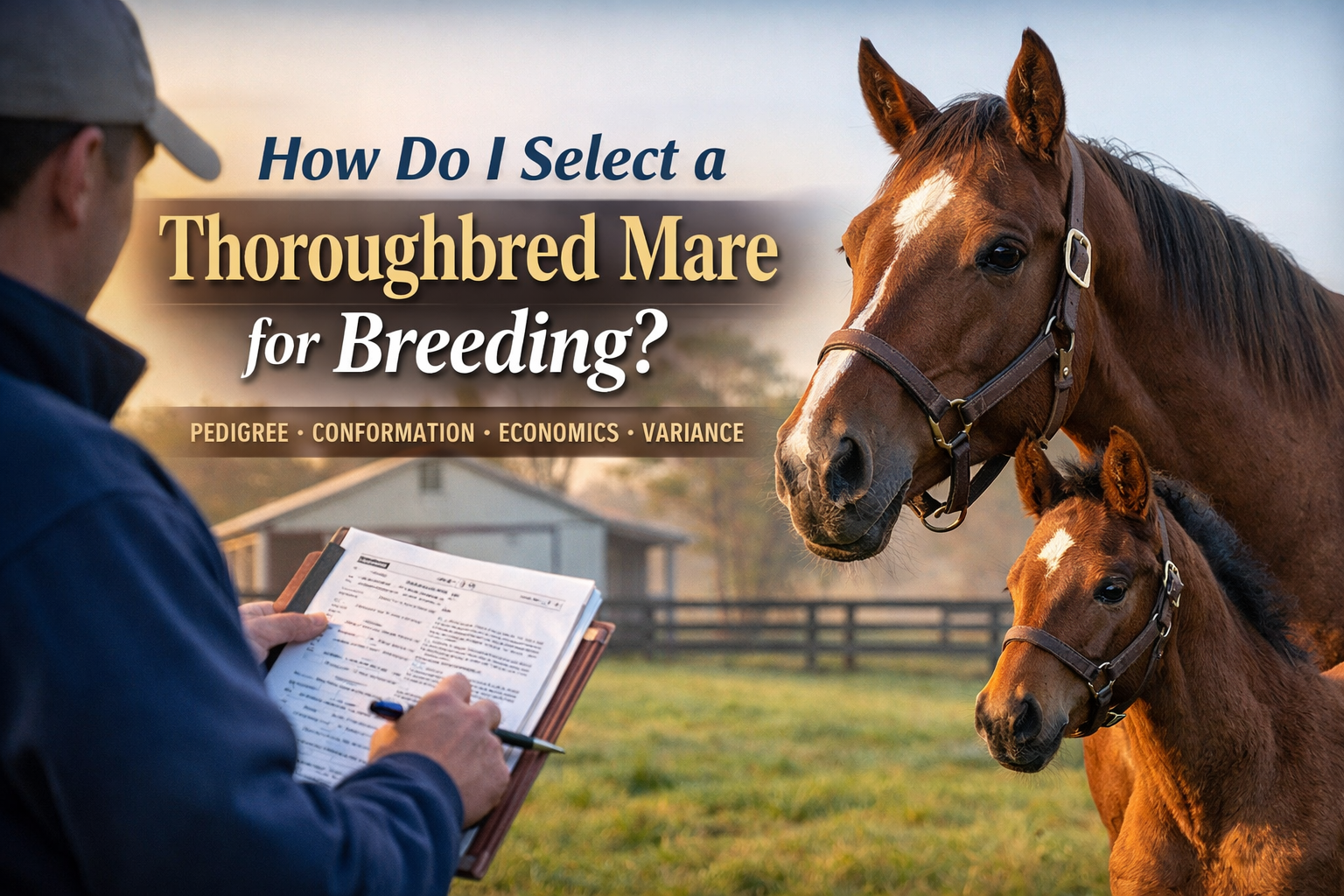
How Do I Select a Thoroughbred Mare for Breeding?
Most people begin in the wrong place. Breeding does not reward excitement. It rewards structure. Breeding is not optimism. It is probability.
Step One, Define the Outcome
Before analyzing a pedigree, decide what you are building.
Are you breeding to race your own foals, sell as weanlings, sell as yearlings, or develop a long term broodmare band? Cash flow changes. Biology does not.
Regardless of strategy, the required outcome is the same. A correct, functional racehorse.
Two failure paths appear repeatedly.
If you select a non commercial stallion because you are breeding to race, and the foal is physically flawed or never makes the track, resale value is limited and the mare’s record weakens.
If you select a fashionable stallion for commercial appeal, but the foal lacks durability or ability, the market eventually discounts the mare.
Different strategies. Same outcome. The mating did not produce a functional racehorse.
The Female Family Is the Engine
When you purchase a mare, you purchase her female line. Not all generations carry equal weight.
The First Dam, Immediate Proof
The mare’s dam carries the strongest current signal. If she has produced winners, durable runners, or stakes performers, the genetics are functioning in real time.
If she has had multiple opportunities with limited production, that is measurable information. Production is measurable. Hope is not.
The Second Dam, Confirmation
The second dam confirms whether the first dam’s results reflect structure. Multiple productive daughters. Repeat runners. Active branches.
If the page narrows quickly behind the first dam, risk increases.
The Deeper Family, Durability
Beyond the second dam, you measure endurance. Has the family produced quality across generations? Has it succeeded with different stallion types? Has it adapted as the breed evolved?
The first two dams show what is working now. The deeper family shows whether it has worked repeatedly.
When recent production and historical depth align, probability improves. When they conflict, variance expands.
Is the Page Growing or Static?
A pedigree is dynamic. It is either growing or it is not.
- Are there current runners in the family?
- Are young horses in training?
- Are daughters actively producing?
Activity closest to the mare carries the most weight. Her own foals performing. Her dam’s recent runners. Young siblings in training.
Fillies matter. Colts win races. Fillies extend the page.
Active structure compounds. Inactive structure plateaus.
Champions Do Not Guarantee Production
Exceptional racemares do not automatically become exceptional producers. History confirms this repeatedly.
An individual can outperform her pedigree. Breeding tests whether that excellence is structurally repeatable.
You are not buying trophies. You are buying probability.
Fashion Does Not Eliminate Variance
High profile pedigrees increase price. They do not remove spread of outcomes.
The market rewards excitement. The racetrack rewards function.
The Body Matters Because Function Matters
Conformation describes how the mare is built. Shoulder angle. Hip alignment. Back length. Limb correctness. Pastern angles.
These structures influence biomechanics. Force distribution. Shock absorption. Stride efficiency.
Uneven force increases stress. Stress increases injury probability. Durability declines.
Some evaluation is measurable. Some is experienced judgment. Severe structural weakness is rarely debated.
Balance matters. Function matters. Appearance is secondary.
Depth Applies to Stallions Too
Once a mare with structural depth is selected, apply the same analysis to stallions.
Evaluate the stallion’s female family. Evaluate repeatability behind the individual. Stallions are not only sons of their sires. They are products of their dams.
Ignoring the female family on either side of a mating means evaluating half of the genetic structure.
Raising Mares at Home Versus Boarding
Boarding costs are often discussed monthly. Daily cost framing provides clarity.
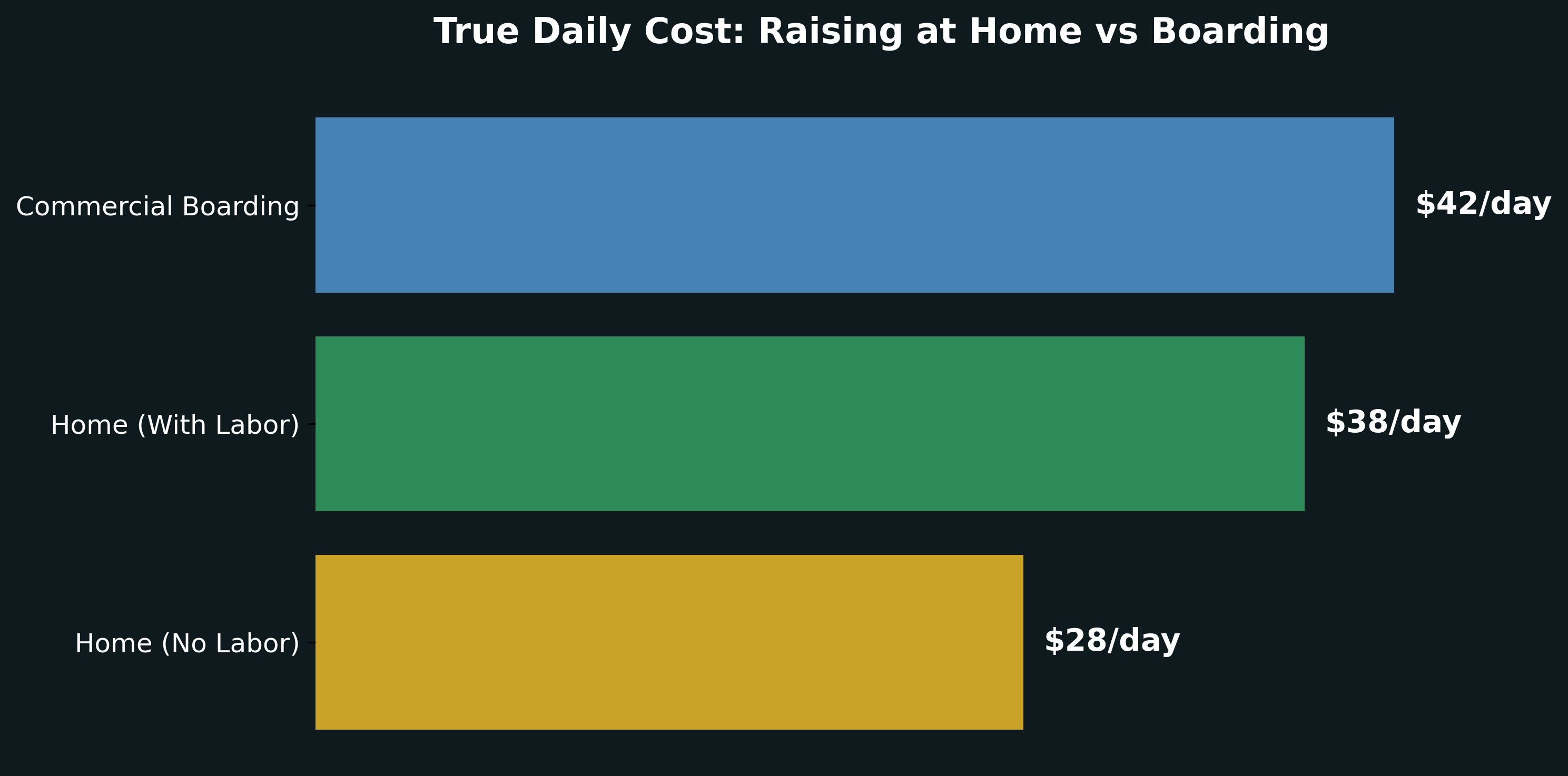
Shared overhead, infrastructure, and labor influence true cost. Without hired labor, daily expenses may approach twenty eight dollars. With labor included, costs move closer to forty dollars. Commercial boarding commonly averages in the low forties per day.
The difference is often scale rather than feed.
If you plan to sell, you compete against professionally raised stock. Lower cost improves margin. Lower quality reduces price.
The Economics Must Be Honest
If comparable horses regularly sell below your projected cost basis, that is structural loss.
Breeding is capital allocation. Hope is not a strategy.
Understanding Variance
Variance is the range between best and worst outcomes. Some mares produce one exceptional runner and little else. Some families repeatedly produce durable, competitive horses.
Risk cannot be eliminated. Variance can be reduced.
- Weight the female family correctly.
- Confirm functional conformation.
- Select stallions with repeatable female family depth.
- Confirm economics before breeding.
Structure first. Everything else follows.