
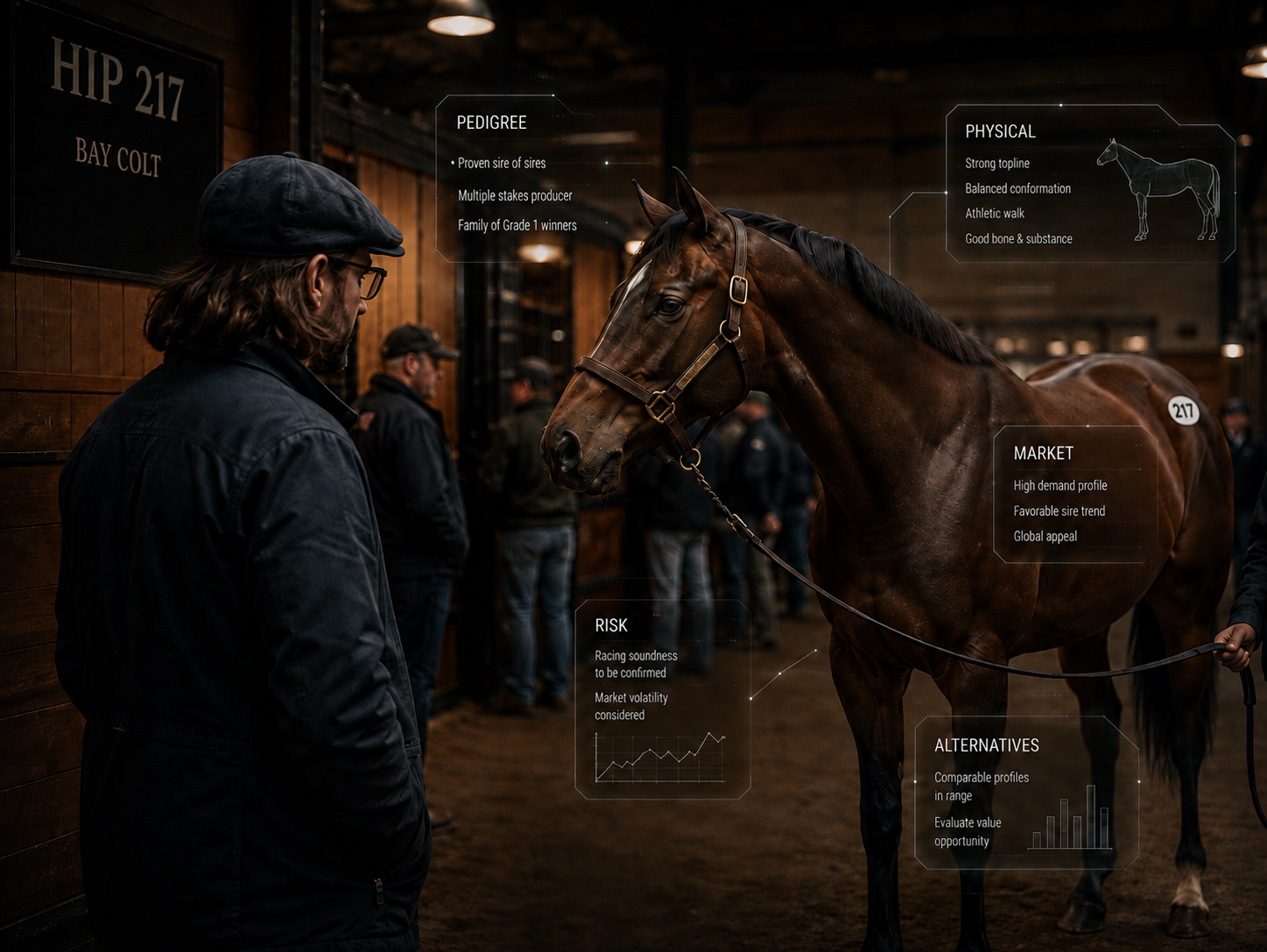
AI Isn't the Horseman. It's the Thinking Partner.
The most useful role for artificial intelligence is not making the decision. It is helping the horseman think more completely before making it.
In the first article of this series, I argued that the biggest opportunity for artificial intelligence in horse racing is not automating office work. It's helping horsemen make better horse decisions.
That naturally leads to the next question.
What should AI actually do?
As more AI products enter the horse industry, every company will promise to save time, increase efficiency, and improve your business. Some of those claims will be true. Others will simply describe features that make existing software a little easier to use.
Horsemen need a better way to evaluate those claims.
Three Questions Every AI Tool Should Answer
I believe every AI tool in horse racing should be judged by three simple questions.
- Does it help me make a better decision?
- Does it help me avoid an expensive mistake?
- Does it create a new opportunity?
If the answer to all three is no, it is probably a convenience feature rather than something that fundamentally changes how a horse business competes.
That doesn't mean convenience has no value. Saving time on administrative work is useful. But saving ten minutes processing invoices is very different from making a breeding decision that increases the value of your next foal, avoiding an expensive yearling purchase that turns out to be a mistake, or identifying a commercial opportunity that others overlooked.
Those are decisions that directly affect the success of a horse business.
A Small Number of Decisions Produce Most of the Results
Horse racing has always been an industry where a relatively small number of decisions produce most of the results.
One mating can transform a broodmare band. One purchase can change a racing stable. One management decision can determine whether a horse reaches its potential or never gets the chance.
Those decisions deserve better tools.
That is where I believe artificial intelligence fits.
Not as the horseman. As the thinking partner.
AI Should Be Another Voice in the Conversation
The phrase is intentional because it describes a relationship rather than a replacement. Artificial intelligence should never become the decision-maker. It should become another voice in the conversation.
Good horsemen already work this way.
A trainer discusses a horse with the veterinarian before deciding whether to race. A breeder reviews mating ideas with a bloodstock agent. A consignor talks through a yearling's progress with the farm manager before deciding whether it is ready for the sale. An owner may seek opinions from trainers, advisors, veterinarians, and partners before making a significant investment.
None of those people makes the final decision.
They contribute information, experience, and perspective.
The horseman decides.
Artificial intelligence should function the same way.
Improve the Discussion, Not Replace It
Its job is not to tell you what to do. Its job is to help you think more completely about the decision in front of you.
Imagine evaluating a mating and asking:
- What historical evidence supports this cross?
- Which comparable mares produced the best commercial results?
- Is there another stallion that offers similar upside at a lower fee?
- What physical strengths or weaknesses should be considered?
- What assumptions am I making that deserve another look?
Notice that none of those questions asks AI to make the decision.
They ask AI to improve the discussion.
That distinction matters because horse racing has never been a business of certainty. No pedigree guarantees a stakes winner. No physical evaluation guarantees a sound horse. No sales analysis guarantees a profitable investment.
Every horse is an individual, and every decision carries risk.
AI Cannot Eliminate Uncertainty
Artificial intelligence cannot eliminate that uncertainty.
Nor should we expect it to.
What it can do is help ensure that decisions are based on more complete information than ever before. It can compare thousands of historical examples, organize research that would otherwise take days to assemble, identify patterns that deserve attention, and present evidence that supports—or challenges—the conclusion you're reaching.
That is the same principle behind Horse Sense pedigree analysis : the objective is not to reduce a horse or mating to one answer, but to bring the relevant evidence into a more structured decision-making process.
AI Can Challenge the Limits of Personal Experience
It can also challenge one of the greatest limitations every horseman has: personal experience.
Every experienced horseman develops opinions. Some are built on decades of success. Others are shaped by memorable horses, successful matings, trusted mentors, or prevailing market trends.
Those opinions are valuable because they are earned.
But every opinion also has limits.
No individual has seen every mating, every female family, every sale, or every training program. We all remember the exceptional horse that proved us right. We are less likely to remember the dozens that quietly disproved the same theory.
Artificial intelligence gives us the opportunity to test those opinions against a much larger body of evidence.
Sometimes the data will confirm what experience already suggests.
Sometimes it won't.
Both outcomes make us better decision-makers.
Experience and AI Contribute Different Strengths
The relationship between AI and horsemen is not one of competition.
It is one of collaboration.
The horseman contributes experience, observation, intuition, and judgment.
AI contributes organization, memory, analytical speed, and the ability to connect information on a scale no individual can match.
Together they create a stronger decision-making process than either could produce alone.
That same approach applies to Thoroughbred sales analysis and bloodstock value prediction , where historical evidence can support professional judgment without pretending that the market can be predicted with certainty.
The Better Question
As artificial intelligence becomes more common in horse racing, I believe the industry should stop asking:
“Can AI do this?”
Instead, we should ask:
“Does AI help me become a better horseman?”
That brings us back to the same three questions.
- Does it help me make a better decision?
- Does it help me avoid an expensive mistake?
- Does it create a new opportunity?
If the answer is yes, it deserves a place in your operation.
If the answer is no, it's probably just another software feature.
The future of horse racing will not belong to the farms with the most artificial intelligence.
It will belong to the horsemen who learn how to use it wisely.