
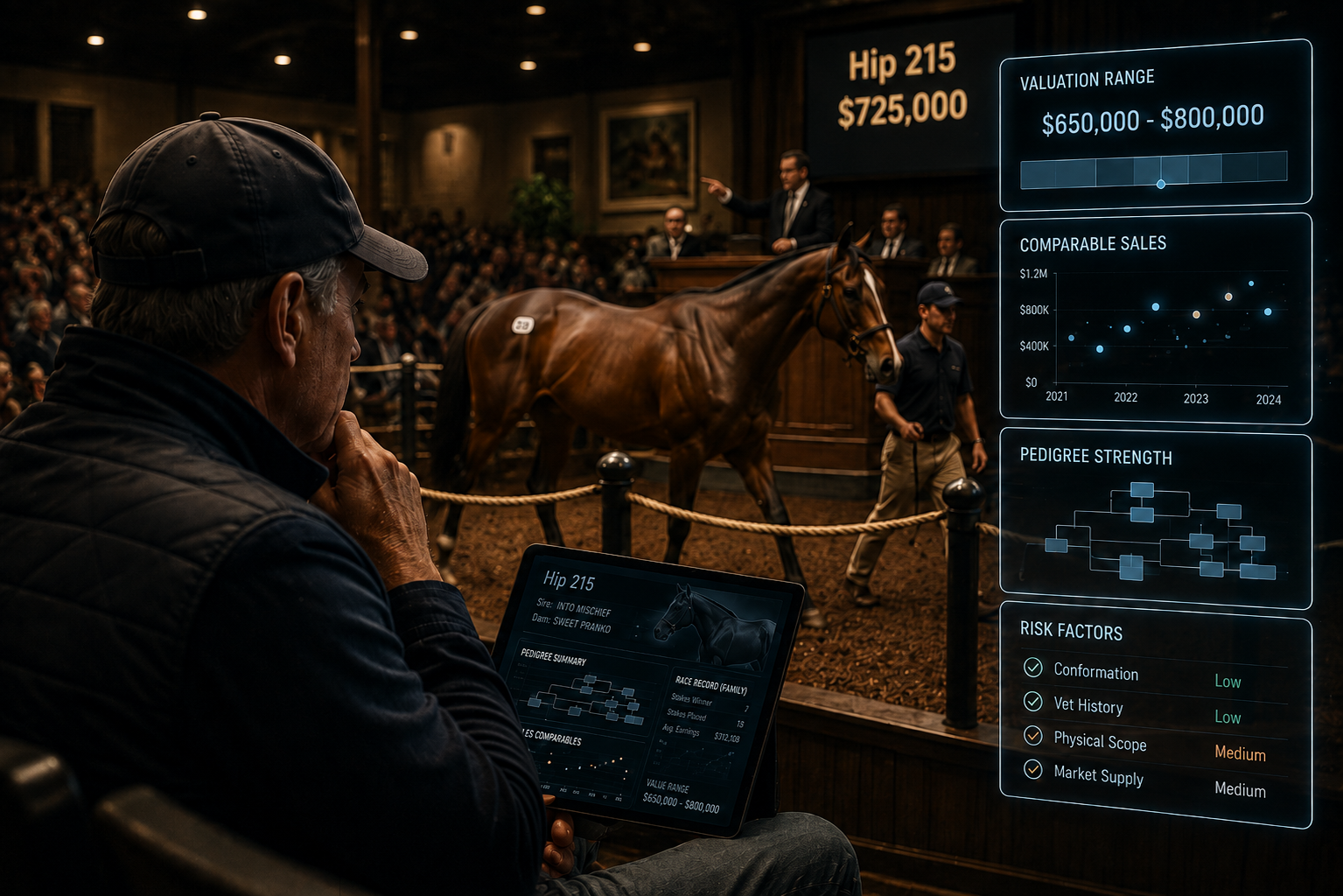
Buying a Horse Is a Decision Made Under Pressure
The sales ring compresses months of preparation into minutes. Artificial intelligence cannot make the decision for the buyer, but it can help make sure the decision is better informed before the bidding begins.
Few industries ask people to make larger financial decisions in less time than the Thoroughbred sales market.
A buyer may spend months preparing for a sale, reviewing catalogs, researching pedigrees, inspecting horses, and developing a shortlist.
Yet when the horse enters the sales ring, the final decision often takes less than two minutes.
In that brief moment, the buyer must decide whether to bid, how much to spend, and whether the horse standing in front of them represents an opportunity or a mistake.
That pressure is part of what makes the sales ring exciting. It is also what makes it difficult.
Every Buyer Walks Into the Sale With Incomplete Information
Even after weeks of preparation, there are questions that cannot be answered with certainty.
How will the horse mature?
Will it remain sound?
Has the market overlooked something important, or is the current price already reflecting every known strength and weakness?
Those uncertainties are unavoidable, and they are part of every successful buyer's job.
Artificial intelligence cannot remove that uncertainty.
What it can do is help buyers arrive at the sale better prepared.
Good Buyers Rarely Rely on One Piece of Information
The most successful buyers rarely rely on one piece of information.
They combine pedigree, physical evaluation, commercial trends, veterinary findings, race performance within the family, and years of personal experience before deciding whether a horse deserves another bid.
That process is demanding because every horse presents a different combination of strengths, weaknesses, and risks.
A strong pedigree does not eliminate physical concerns.
A good physical does not automatically make the horse good value.
A successful sire does not mean every individual by that sire deserves the same price.
This is why Thoroughbred sales analysis becomes most useful when it is combined with evaluation of the individual horse rather than treated as a substitute for it.
AI Can Organize the Work Before the Auction Begins
Artificial intelligence can help organize those pieces before the auction ever begins.
Rather than replacing the buyer's judgment, it can assemble research, identify comparable examples, summarize historical information, and highlight questions that deserve another look.
The buyer still decides whether the horse represents value.
But the decision can be made with a more complete understanding of the available evidence.
That is also the principle behind bloodstock value prediction . A forecast should not tell a buyer what a horse is worth with certainty. It should provide a reference range that can be considered alongside the pedigree, physical, market, and the buyer's own opinion of the horse.
Preparation Matters Because the Final Decision Happens Fast
The sales ring leaves very little time to rebuild an analysis from scratch.
Once bidding begins, a buyer should already understand why the horse is on the list, what strengths justify the purchase, what risks remain, and approximately where the horse fits within the buyer's valuation.
Artificial intelligence is useful before that moment because it can help organize the information while there is still time to examine the assumptions behind it.
The purpose is not to replace the final judgment.
It is to make sure that judgment is being made from a stronger starting point.
Emotion Changes Auction Behavior
Perhaps more importantly, AI can help buyers remain disciplined.
One of the greatest challenges in any auction is emotion.
Competition changes behavior.
A horse that seemed fairly valued ten minutes earlier can suddenly become irresistible once another bidder becomes involved.
Buyers convince themselves that stretching a little further is justified because they fear missing the opportunity.
Experienced horsemen recognize that feeling because they have all experienced it.
AI Can Provide an Objective Point of Reference
Artificial intelligence cannot remove emotion from the sales ring.
But it can provide an objective point of reference before emotions begin to influence the decision.
It can remind buyers why a horse was originally placed within a certain range, identify the assumptions supporting that opinion, and encourage them to reconsider whether anything meaningful has changed besides the bidding itself.
That distinction matters.
If new information changes the evaluation, the buyer may have a legitimate reason to reconsider the price.
If nothing has changed except the presence of another bidder, the original analysis still deserves consideration.
AI Should Not Tell a Buyer When to Stop Bidding
That does not mean AI should tell a buyer when to stop bidding.
Only the buyer can decide how much risk is acceptable or how badly they want a particular horse.
Those decisions depend on budget, business strategy, and confidence in the individual standing in front of them.
Artificial intelligence simply provides another perspective before the decision becomes irreversible.
The same distinction runs throughout the Horse Sense analytical process : data and analysis support the decision, but the final judgment remains with the horseman.
Value Is More Than the Sale Price
The question in the sales ring is not simply whether a horse is expensive or cheap.
The more important question is whether the price is justified by the opportunity represented by that individual horse.
A horse selling below an average can still be poor value if the underlying risks are greater than the price reflects.
A horse selling above an average can still represent an opportunity if the buyer has identified qualities the broader market has not fully appreciated.
Historical data can provide context.
It cannot replace the evaluation of the horse standing in front of you.
The Sales Ring Rewards Preparation
The sales ring rewards preparation far more often than impulse.
The buyers who consistently succeed are usually those who have done the work long before the auctioneer begins calling bids.
They know what they are looking for, what they are willing to pay, and why they reached those conclusions.
Artificial intelligence has the potential to strengthen that preparation.
It can help buyers organize research more efficiently, challenge assumptions before money is committed, and ensure that important information has not been overlooked.
Most importantly, it allows buyers to spend less time collecting information and more time evaluating the horse itself.
Where AI Belongs in the Sales Ring
That is where AI belongs in the sales ring.
Not as the bidder.
Not as the decision-maker.
But as another trusted advisor whose purpose is to help the buyer make a more informed decision before the hammer falls.