
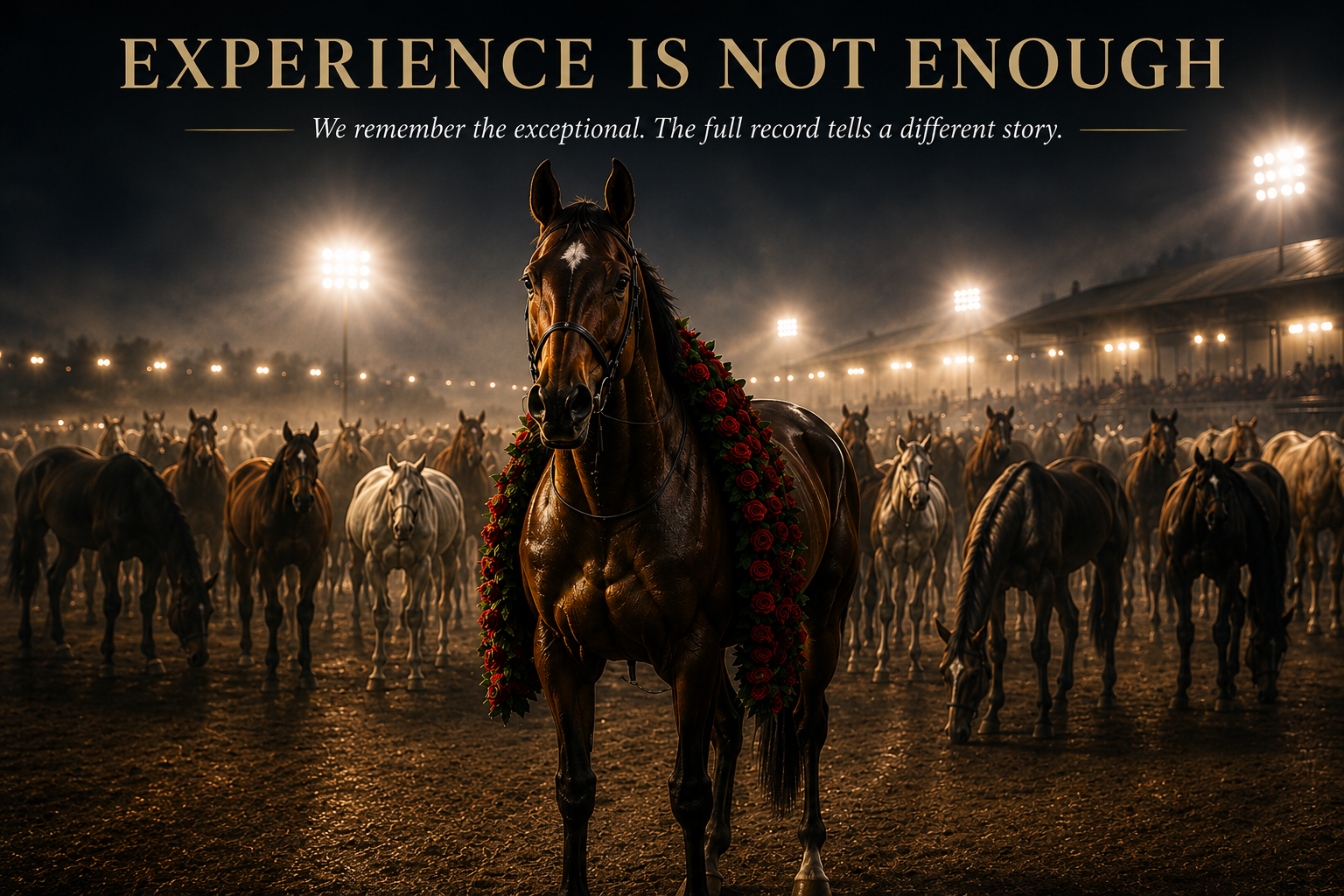
Experience Is Not Enough
Experience creates judgment, but memory is selective. Artificial intelligence can help horsemen test whether a memorable example represents a real pattern or an exception.
Horse racing values experience above almost everything else, and for good reason.
Experience teaches lessons that cannot be learned from a textbook or database. It teaches patience, timing, judgment, and the ability to recognize subtle details that often separate an average horse from a special one.
Those lessons are earned one horse at a time, usually over years or decades, and no technology should be expected to replace them.
Experience, however, has limits.
Human Memory Is Selective
No breeder remembers every mating they have studied.
No bloodstock agent remembers every yearling they have inspected.
No trainer remembers every horse they have conditioned, and no veterinarian remembers every case they have treated.
Human memory is selective.
We remember the exceptional horse, the expensive mistake, the stakes winner that looked different from the rest, and the yearling everyone criticized that later became a champion.
Those experiences shape our judgment.
But they also shape our biases.
Memorable Experiences Are Not Always Representative
That is not a criticism of horsemen. It is simply how people learn.
The challenge is that memorable experiences are not always representative experiences.
If a breeder sees one mating produce an outstanding runner, it is natural to think positively about repeating that cross.
If a trainer experiences repeated soundness issues with a particular physical type, those cases will influence future evaluations.
Those instincts may be correct, but they are often built on a relatively small sample compared with the thousands of horses that have raced, sold, or entered breeding programs during the same period.
AI Has a Different Kind of Memory
Artificial intelligence offers something people cannot:
The ability to retain and compare every example it has been given.
It does not remember only the champion.
It also remembers the fifty average horses that looked similar, the horses that failed, and the horses that exceeded expectations.
More importantly, it does not automatically give greater weight to the examples that created the strongest emotional impression.
That difference between individual memory and broader evidence is one reason statistical pedigree analysis and traditional pedigree analysis can produce different perspectives on the same mating.
Memory and Judgment Are Not the Same Thing
That does not mean AI has better judgment.
It means AI has a different kind of memory.
And memory and judgment are not the same thing.
A horseman may instantly recognize that a colt resembles one seen twenty years ago.
Artificial intelligence can place that observation alongside hundreds or thousands of comparable examples and ask whether the memorable horse was typical or the exception.
That may be one of the most valuable questions AI can introduce into the decision-making process.
Test Experience Rather Than Dismiss It
AI does not challenge experience merely to prove it wrong.
It tests experience by asking whether the available evidence supports what we believe to be true.
Sometimes the evidence will confirm the horseman's instinct.
Sometimes it will not.
Both outcomes improve the quality of the decision.
The same principle applies when evaluating a mating through the Horse Sense decision process . A breeder's initial opinion remains important, but pedigree, physical, family, commercial, and market evidence can test whether the initial reasoning remains supported when the entire picture is considered.
Intuition Is One of Horsemanship's Greatest Strengths
One of the greatest strengths of experienced horsemen is intuition.
They develop an instinct for horses that is difficult to explain but often remarkably accurate.
They notice details others overlook and recognize patterns before they become obvious.
Artificial intelligence should not replace that intuition.
It should provide a way to test it.
What Happens When Intuition and Evidence Disagree?
When intuition and evidence point in the same direction, confidence in the decision increases.
When they point in different directions, that does not automatically mean the horseman is wrong or the technology is right.
It means the question deserves another look.
That second look may reveal missing information, expose a weak assumption, or confirm that the horse in front of you really is an exception.
This becomes especially important in Thoroughbred sales analysis , where a buyer's judgment of the individual horse may differ from historical commercial evidence.
Neither should automatically replace the other. The disagreement itself may be valuable information.
Better Decisions Require Experience and Evidence
Better decisions do not come from trusting technology over experience or experience over evidence.
They come from allowing each to challenge and strengthen the other.
The best horsemen of the future will not succeed because they ignore artificial intelligence, nor because they blindly follow it.
They will succeed because they combine horsemanship with the ability to test their instincts against a broader body of evidence than any previous generation could realistically process.
Experience Still Matters
Experience will always be one of horse racing's greatest assets.
Artificial intelligence simply gives that experience a longer and more complete memory.
And better memory can lead to better decisions.