
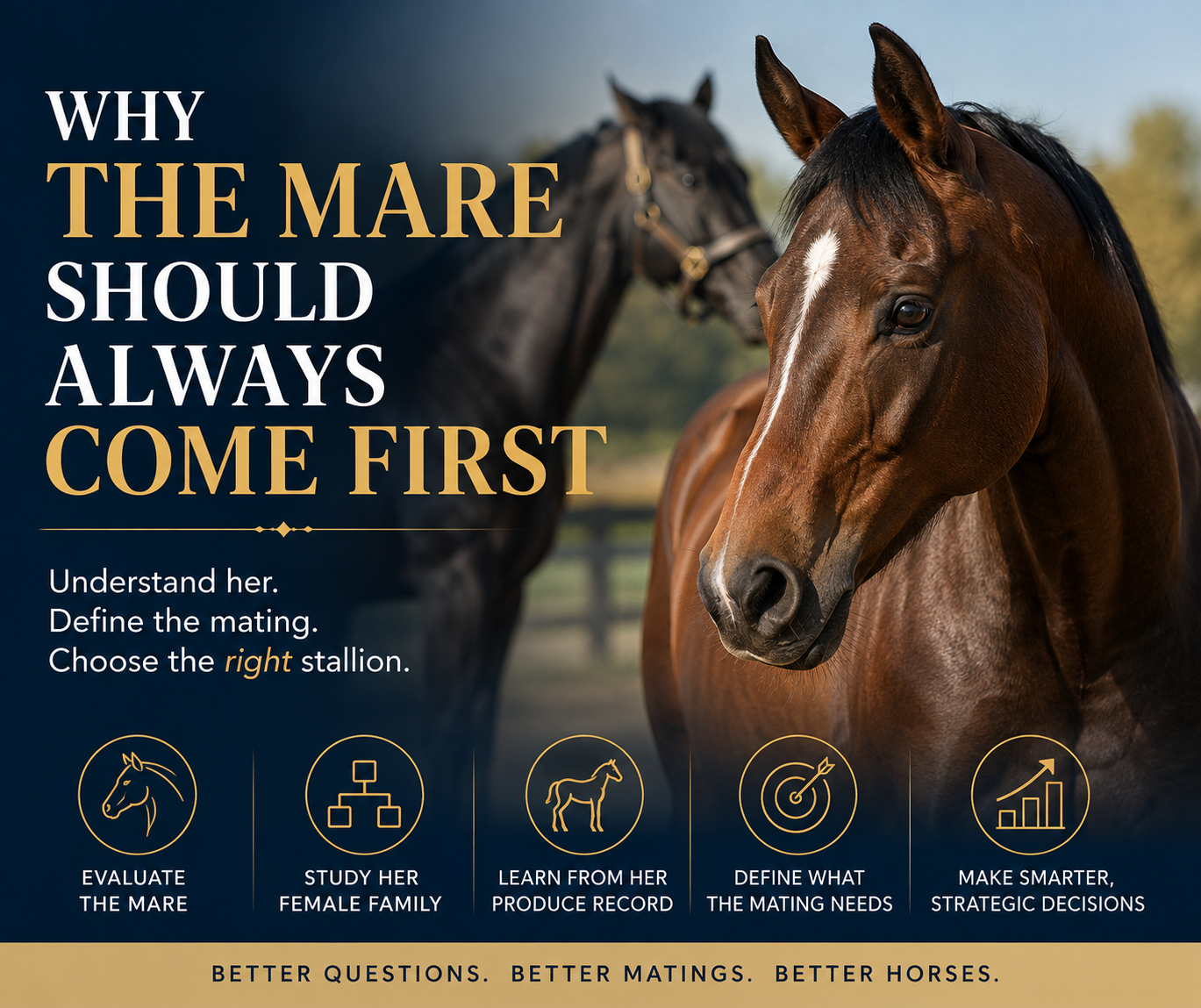
Why the Mare Should Always Come First
The best Thoroughbred mating decisions do not begin by asking which stallion is most fashionable. They begin by understanding the mare.
One of the first questions breeders ask each breeding season is, "Which stallion should I breed my mare to?"
It is an understandable question. Stallion advertisements fill the magazines, stud farms promote their newest recruits, and sales companies publish pages of statistics highlighting the latest commercial success. Before long, breeders are comparing stud fees, sales averages, nick ratings, and first-year demand.
The problem is that this question starts the process in the wrong place.
Before we can decide which stallion is right, we first have to understand the mare.
The mare is not simply half of the pedigree. She is the foundation of every mating decision. She is the horse standing in front of us. We know her physical makeup, her race record, her temperament, her family, and often her produce record. She is the only part of the equation we can evaluate with certainty before a mating ever takes place.
The stallion is selected because of the mare, not the other way around.
That may seem obvious, but many breeding decisions begin with the stallion and work backward. A breeder falls in love with a fashionable freshman sire, an impressive sales average, or an exceptional nick rating. Once that happens, it becomes surprisingly easy to convince ourselves that the stallion is the perfect choice. Instead of objectively evaluating the mare's needs, we begin searching for reasons to justify a decision that has already been made.
The better approach is much simpler.
Start by asking what the mare needs
Instead of beginning with a stallion list, ask a different question: What does this mare need?
Everything else follows from that answer.
The first step is evaluating the mare as an individual, not simply as a pedigree. Two mares with nearly identical bloodlines can require completely different stallions because they are physically different horses. One may be substantial and powerful, while the other is refined and lighter made. One may mature early, while the other takes time to develop. One may consistently produce athletic, correct foals, while another passes along the same structural weakness generation after generation.
None of those differences can be found by looking at a five-generation pedigree alone.
Physical evaluation establishes the mating objective
This is why physical evaluation comes first. Understanding the mare's balance, structure, movement, athletic traits, and overall conformation establishes what should be maintained and where improvement may be possible. The goal is not to create a list of faults that need fixing. Every mare has strengths that deserve to be protected.
That distinction is important.
Too often breeders approach mating decisions as though every breeding is an exercise in correcting flaws. While it is certainly desirable to improve weaknesses where possible, it is equally important to identify the qualities that make the mare valuable in the first place. If she has exceptional balance, scope, toughness, or athleticism, those characteristics should not be sacrificed simply because another stallion offers a more fashionable pedigree or a stronger statistical nick.
A successful mating preserves the mare's best qualities while complementing the areas where improvement is possible.
The immediate female family provides evidence
The female family adds another layer of understanding.
When evaluating a mare's pedigree, the first and second dams deserve the greatest attention. These are the generations most likely to reveal what the family consistently produces. Does the family repeatedly produce sound horses? Do they mature early? Are they successful over classic distances or do they show speed? Have they produced runners, producers, or both?
Patterns matter.
Recognizable names buried four or five generations back may be interesting, but they rarely carry the same practical value as understanding what the immediate female family has accomplished. The question is not how many famous ancestors appear on the page. The question is whether this female family has demonstrated a consistent ability to produce quality racehorses.
Horse Sense evaluates this type of female-family evidence through pedigree analysis designed to separate meaningful, repeatable production from names that simply make a catalog page look attractive. Learn more about FemaleLineSignal.
The mare's foals eventually become part of the evidence
As mares age, another source of information becomes available.
Their foals begin telling the story.
Some mares consistently throw size regardless of the stallion. Others stamp every foal with the same head, shoulder, or hind leg. Some produce exceptional athletes but lack commercial appeal. Others generate attractive yearlings that struggle once they reach the racetrack.
These patterns are invaluable because they represent real evidence instead of educated guesses.
Every foal teaches us something about what the mare contributes genetically. Good breeders pay attention to those lessons and allow the mare's produce record to influence future mating decisions.
Only then should the stallion search begin
Only after the mare has been thoroughly evaluated should the search for a stallion begin.
Notice that we are no longer looking for a particular horse. Instead, we are defining the characteristics the stallion must bring to the mating.
The mare may require a stallion with a stronger topline, more scope, greater athleticism, improved commercial appeal, or additional precocity. She may instead benefit from added refinement without sacrificing substance, an outcross pedigree, or a sire capable of improving durability in a family that has shown brilliance but limited soundness.
Now the stallion search has direction.
Physical compatibility, pedigree construction, racing aptitude, commercial demand, stud fee, sales performance, nicking analysis, and economic projections all become valuable tools because they are answering a specific question rather than driving the decision themselves.
Why starting with the stallion can distort the decision
This is where many modern breeding programs lose their way.
Breeders often begin with the latest sales leader or the hottest young stallion and hope the mating makes sense afterward. A strong nick becomes more important than the individual horse. Sales averages overshadow physical compatibility. Fashion replaces strategy.
The result is a mating built around the stallion instead of the mare.
A mare-first approach forces discipline into the process. It requires breeders to understand the problem before searching for the solution.
How AI strengthens a mare-first breeding strategy
Artificial intelligence has the potential to make this approach even stronger.
An AI system can organize physical evaluations, female-family performance, produce records, pedigree construction, sales analytics, nicking information, and commercial forecasting in ways that would have required days or weeks of research in the past. It can compare hundreds of variables simultaneously and identify patterns that might otherwise go unnoticed.
However, AI is only as good as the information it receives.
If the mare has not been properly evaluated, the recommendations will be built on an incomplete foundation. The most sophisticated technology in the world cannot compensate for asking the wrong question.
The quality of the analysis begins with the quality of the mare evaluation.
The mare defines the mating
That is why every mating decision should start with the mare.
She defines the objectives of the mating. She tells us what qualities deserve to be preserved, what characteristics should be strengthened, and what genetic opportunities exist within her family. Only after those questions have been answered should we begin evaluating stallions.
The stallion does not define the mating.
The mare does.
Frequently Asked Questions
Why should a Thoroughbred breeder evaluate the mare before choosing a stallion?
The mare establishes the starting point of the mating. Her physical traits, female family, race record, produce history, strengths, and weaknesses determine what qualities should be preserved or improved. Stallion selection is more useful once those objectives have been defined.
What should breeders evaluate in a broodmare before selecting a stallion?
A mare evaluation should consider balance, structure, movement, athletic traits, race performance, immediate female family, produce record, and recurring characteristics in her foals. Together, these factors provide the foundation for comparing potential stallions.
How important is the female family in Thoroughbred breeding?
The immediate female family can reveal repeatable patterns in racing ability, soundness, maturity, distance aptitude, and producing ability. For practical mating decisions, the first and second dams generally provide more meaningful evidence than recognizable names several generations farther back.
Where do nick ratings, sales averages, and stud fees fit into the process?
They are valuable secondary tools. Once the mare has been evaluated and the breeding objective is clear, nicking, commercial demand, sales performance, stud fee, pedigree construction, and economic forecasting can help compare stallions that actually fit the mare.
How can Horse Sense help evaluate a mating?
Horse Sense Pedigree Analytics combines pedigree analysis, female-family evaluation, physical compatibility, sales information, commercial forecasting, and AI-supported analysis to help breeders compare mating options from a mare-first perspective.
— Horse Sense Pedigree Analytics